
hyogo
- Ships frozen in an insulated cooler with ice gel packs
- Arrives perfect. We will always make it right.
- Certificate with every Japanese A5 order
- Same-day delivery in Los Angeles with personal concierge
- Text your concierge (310) 683-7078 · call (310) 683-7076
Not sure where to start?
Our concierge's picks. Every one is in stock and ready to ship.
-
For first-timers
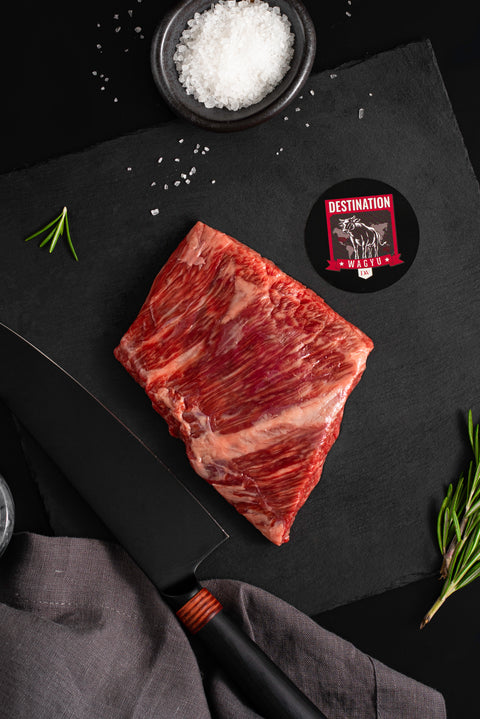
Kagoshima Rib Cap Steak
Kagoshima, Japan · A5 · BMS 11
8 oz · serves 1–2
The most accessible way to taste A5.
$55.00 -
Our #1 steak
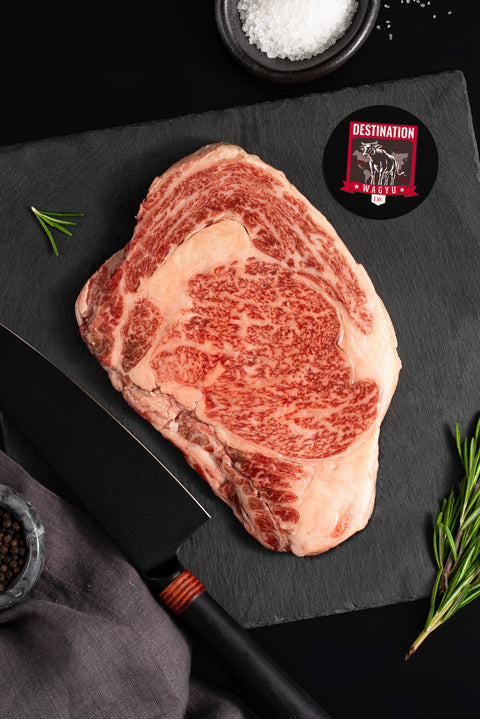
A5 Japanese Miyazaki Wagyu Ribeye Steak
Miyazaki, Japan · A5 · BMS 11
16 oz · serves 3–4
The most-ordered steak in the store.
$175.00 -
For everyday A5
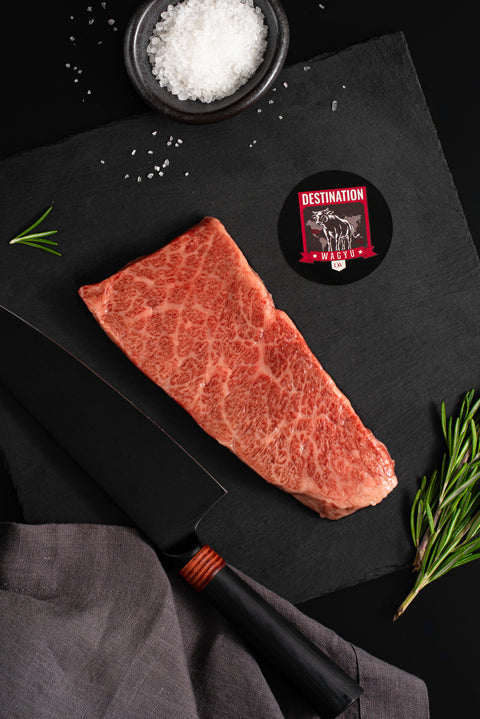
A5 Japanese Miyazaki Wagyu Denver Steak
Miyazaki, Japan · A5 · BMS 11
8 oz · serves 1–2
Big marbling, friendliest price per ounce.
$80.00 -
For gifting
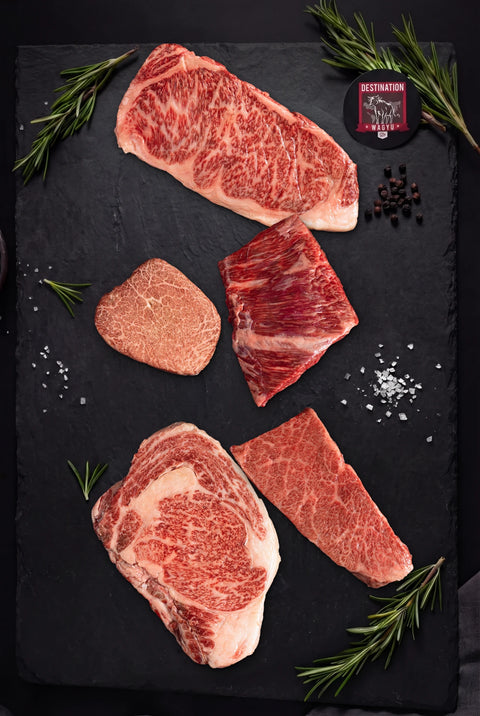
The Japanese A5 Wagyu Experience Box
Miyazaki · Kagoshima · Hyōgo, Japan · A5 · BMS 11-12
52 oz · serves 8–13
Three prefectures side by side. Top-tier gift included.
$600.00
What do A5, BMS and marble score mean?
Japanese A5 is the top grade in Japan. Marbling is scored on the 12-point BMS scale, and A5 requires BMS 8–12. Most of our Japanese cuts are BMS 11.
Australian beef uses the AUS-MEAT marble score, which tops out at 9+. 9+ is the highest possible Australian marble score, and many of our Full Blood cuts are graded 9+.
Richer marbling means smaller portions: 4–5 oz of A5 per person, 7–8 oz of Australian BMS 9+, 8–10 oz of American or lower-BMS cuts. The full BMS guide
-
A5 Japanese Kobe Wine Wagyu NY Striploin Steak
Kobe Wine · Hyōgo, JapanA5 · BMS 11Serves 2–3
Vendor:Destination Wagyu -
Japanese A5 Wagyu | Kobe Wine Filet Steak
Kobe Wine · Hyōgo, JapanA5 · BMS 11Serves 1–2
Vendor:Destination Wagyu -
A5 Japanese Kobe Wine Wagyu Ribeye Steak
Kobe Wine · Hyōgo, JapanA5 · BMS 11Serves 3–4
Vendor:Destination Wagyu -
Japanese A5 Kobe Wine Wagyu Box | 3-Cut Collection
Kobe Wine · Hyōgo, JapanA5 · BMS 11Serves 6–9
- Ribeye16 oz
- NY Striploin12 oz
- Filet8 oz
Vendor:Destination Wagyu


Complimentary with your order
- $250+Complimentary Wagyu gift
+ free 2-day shipping - $350+Premium gift
- $500+Top-tier gift
+ free next-day shipping
Your gift is chosen in the cart once your order qualifies.
A5 by origin and cut
In-stock cuts only. Serves uses our portion guide: 4–5 oz of Japanese A5 per person, 7–8 oz of Australian BMS 9+, 8–10 oz of American or lower-BMS Wagyu.
| Cut | Origin | Grade | Weight | Price | $/oz | Serves |
|---|---|---|---|---|---|---|
| A5 Japanese Kobe Wine Wagyu NY Striploin Steak | Kobe Wine · Hyōgo, Japan | A5 · BMS 11 | 12 oz | $135 | $11.25 | 2–3 |
| Kobe Wine Filet Steak | Kobe Wine · Hyōgo, Japan | A5 · BMS 11 | 8 oz | $160 | $20.00 | 1–2 |
| A5 Japanese Kobe Wine Wagyu Ribeye Steak | Kobe Wine · Hyōgo, Japan | A5 · BMS 11 | 16 oz | $190 | $11.87 | 3–4 |
| Japanese A5 Kobe Wine Wagyu Box | 3-Cut Collection | Kobe Wine · Hyōgo, Japan | A5 · BMS 11 | 36 oz | $475 | $13.19 | 6–9 |
Certificate of authenticity
Every Japanese A5 order ships with its certificate of authenticity
- The individual identification number of the animal
- Date of birth, origin, harvest place and breed
- The grade: A5, with its BMS score

Japanese A5 Wagyu, in two lines
A5 is the top grade Japan gives beef: A for the highest yield, 5 for the highest meat quality, which requires marbling of BMS 8 to 12 on Japan's 12-point scale. For the full explanation of the grade, taste and preparation, read our A5 Wagyu steak guide.
Shop A5 Wagyu steaks by cut
Start with how you'll serve it. For a tasting where everyone gets a few slices, choose the most marbled cuts: ribeye or rib cap. For two people who want a tender, elegant bite, choose filet. For a classic steakhouse texture, choose striploin. For the most A5 per dollar, choose Denver or picanha.
A5 Wagyu ribeye
The most marbling and the most flavor. We carry three: the Miyazaki Ribeye (16 oz, $175), our #1 seller; the Kagoshima Ribeye (12 oz, $125); and the Kobe Wine Ribeye (16 oz, $190). Compare them on our Japanese A5 Wagyu ribeye page, or taste two origins side by side in the Ribeye Experience Box.
A5 Wagyu filet
The most tender cut and the most expensive per ounce, about $20/oz. The Miyazaki Filet (8 oz, $165) and Kobe Wine Filet (8 oz, $160) each serve two. The Miyazaki Petite Filet (4 oz, $85) is the smallest way into Miyazaki A5.
A5 Wagyu NY Striploin
Firm, beefy and balanced. The Kobe Wine NY Striploin (12 oz, $135) is our #2 seller overall. The Miyazaki Striploin (10 oz, $115) is a classic steakhouse cut in A5 form.
Denver and picanha
Big marbling at the friendliest price per ounce. The Miyazaki Denver (8 oz, $80) is our everyday Miyazaki cut. The Kagoshima Picanha (8 oz, $80) has a fat cap that sears beautifully.
Rib cap, sirloin and skirt
The Kagoshima Rib Cap (8 oz, $55) is the most accessible way to taste A5; see the Wagyu ribeye cap page. Kagoshima Top Sirloin (8 oz, $75) is the leaner A5 choice, and the Kagoshima Inside Skirt (8 oz, $60) is made for searing and slicing.
Miyazaki, Kagoshima or Kobe Wine: which origin?
- Miyazaki A5 Wagyu: Miyazaki Prefecture's Wagyu won the Prime Minister's Award at four consecutive national Wagyu competitions, held every five years, spanning 15 years (2007–2022). Fine, even marbling and a clean, buttery finish.
- Kagoshima A5 Wagyu: from southern Kyūshū. Kagoshima placed first in 6 of 9 categories at Japan's 2022 National Wagyu Competition (the 12th Zenkyo). It gives the widest range of cuts we carry, from rib cap to picanha.
- Kobe Wine A5 Wagyu (Hyōgo): Japanese Black cattle raised in Hyōgo Prefecture on feed that includes by-products of Kobe Wine production. Kobe Wine is its own brand, not certified Kobe Beef, and we label it that way.
A5 Wagyu price
Our Japanese A5 steaks run from $55 (Kagoshima Rib Cap, 8 oz) to $190 (Kobe Wine Ribeye, 16 oz), roughly $7 to $21 per ounce depending on the cut. Experience boxes run $250 to $600, and a whole Miyazaki boneless striploin (11 lb) is $1,375. Filets cost the most per ounce; ribeye, striploin and Denver give the most A5 per dollar. Our pricing stays the same all year. For what drives the cost, see our A5 Wagyu price breakdown.
How much A5 per person, and how thick
A5 is very rich. Plan on 3 to 4 ounces per person, sliced and seared. Cut it about ¾ inch or thinner. A 16 oz ribeye serves four to five, and an 8 oz filet serves two. More in our portion size guide.
How to cook it (the short version)
Bring it to room temperature. Sear hard in a dry cast-iron pan for about a minute a side. Salt at the end. Rest briefly and serve in small slices.
How to know it's authentic
Every Japanese cut we sell is graded A5 in Japan, and every Japanese order ships with a certificate. Japanese beef can also be traced by each animal's 10-digit individual identification number, which records the farm and lineage. See How to verify your A5 Wagyu is the real thing.
How we ship and our promise
Every order ships frozen in a styrofoam cooler wrapped in insulated Cool Shield bubble wrap with ice gel packs, from Los Angeles by FedEx 2-Day Air or Overnight, Monday to Thursday (order by 12 PM PT for same-day processing). In Los Angeles we also offer same-day delivery with personal concierge service. Orders of $250+ ship free 2-day with a complimentary Wagyu gift; $350+ adds a premium gift; $500+ ships free next-day with our top-tier gift. Arrives perfect. We will always make it right.
Talk to a person, not a chatbot
Your concierge personally helps you choose and cook, even mid-sear. Text (310) 683-7078 or call (310) 683-7076.
Sources: Miyazaki awards from pref.miyazaki.lg.jp and miyazakigyu.jp; Kagoshima 2022 result from pref.kagoshima.jp; grading from the Japan Meat Grading Association.
Questions, answered
Is your Japanese A5 Wagyu authentic?
Yes. Every Japanese cut we sell is graded A5 in Japan under the Japan Meat Grading Association's system, and every Japanese order ships with a certificate.
What BMS are your A5 cuts?
Most of our Japanese A5 cuts are graded BMS 11 on Japan's 12-point Beef Marbling Standard. The exact grade is on each product page.
Which A5 Wagyu steak should I choose?
For the most marbling, the ribeye, such as our 16 oz Miyazaki A5 Ribeye. For tenderness, the filet. For everyday value, the Miyazaki Denver or Kagoshima Picanha.
How much do your A5 Wagyu steaks cost?
From $55 for an 8 oz Kagoshima Rib Cap to $190 for a 16 oz Kobe Wine Ribeye, about $7 to $21 per ounce depending on the cut.
How much A5 Wagyu should I buy per person?
Plan on 3 to 4 ounces per person. A5 is rich, so it's served in small slices. A 16 oz ribeye serves four to five.
How is it shipped?
Frozen, in a styrofoam cooler with insulated Cool Shield bubble wrap and ice gel packs. We ship Monday to Thursday from Los Angeles for weekday delivery, and offer same-day delivery in Los Angeles. Free 2-day shipping on orders of $250+, free next-day at $500+.
What if something isn't right?
Arrives perfect. We will always make it right. Text your concierge at (310) 683-7078 and your concierge will take care of it personally.
Explore by origin
- Japanese A5 WagyuMiyazaki, Kagoshima and Kobe Wine. A5, most cuts BMS 11.
- Kagoshima A5 WagyuKagoshima Prefecture, Japan. Graded A5.
- Miyazaki A5 WagyuMiyazaki Prefecture, Japan. A5, BMS 11.
- Kobe Wine A5 WagyuHyōgo Prefecture, Japan. A5, BMS 11.
- Australian WagyuFull Blood and purebred, from respected Australian farms.
- American WagyuUS-raised. Made for the grill.
- Wagyu Gift BoxesCurated sets from $160 to $600.
Questions about a cut, or help mid-sear?
Text your concierge.
Your concierge answers personally.